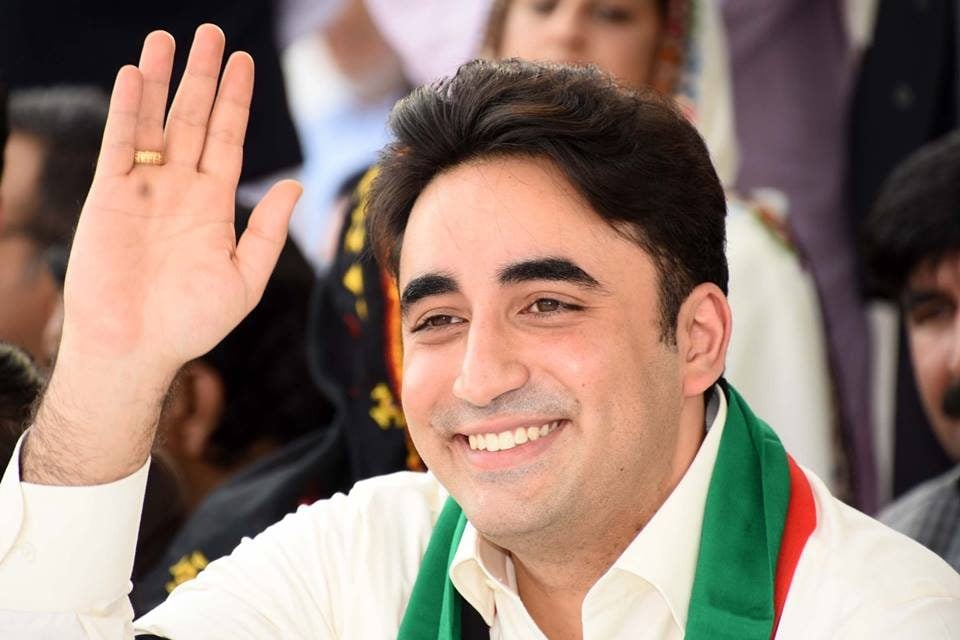
Bilawal Bhutto Zardari visited Multan yesterday. A prominent politician from Multan, Rana Mahmood ul Hassan, had a meeting with him, and he decided to join the Pakistan Peoples Party. It is a significant development that, after the assassination of Benazir Bhutto, the People’s Party is strengthening its political position in Punjab for the first time. Bilawal Bhutto is contesting elections from Lahore, and his rallies have begun in Punjab. His sister, Aseefa Bhutto, is actively supporting Bilawal and leading their electoral campaign. In an interview with ARY News, Bilawal emphasized that, to strengthen democracy in Pakistan, the initiative should be taken by politicians, not the military or judiciary. He stated that he is continuing the legacy of his late mother, Benazir Bhutto, and father, Asif Ali Zardari, promoting a policy of reconciliation and tolerance. He criticized Nawaz Sharif, saying it seems he hasn’t learned anything from the past and is more interested in becoming the fourth-time Prime Minister on the establishment’s support.
I perceive Bilawal Bhutto Zardari as a shrewd and astute politician, reminiscent of his mother. His stance on strengthening democracy in Pakistan is clear. Recently, he asserted that the People’s Party began its political journey with socialist ideals. In my opinion, socialism is not currently a prominent feature in Pakistan’s electoral politics. The political landscape is dominated by a capitalist mafia consisting of military aristocracy, politicians, civil bureaucracy, and the judiciary. Not just the masses but even the educated middle class in Pakistan seems detached from political wisdom. This is evident in the popularity of an incompetent figure like Imran Khan in the middle class. The electoral politics of the last 16 years has failed to change the economic conditions for the poor. Therefore, the question arises whether Bilawal’s democratic ideals will be beneficial for the people in the future. Bilawal’s politics represents liberal democracy, which may work in developed countries, but it remains to be seen if it is suitable for countries like Pakistan and India. Democratic idealists claim to solve the problems of the poor, but, in reality, they often become part of the capitalist mafia’s power game. For the capitalist mafia, democracy or autocracy holds no meaning. They are only interested in sipping the blood of the hardworking public and filling their coffers.
The founder and chairman of the People’s Party, the late Zulfikar Ali Bhutto, wrote a book titled ‘If I am Assassinated’ while in jail. In it, he explicitly stated that reconciliation between capitalists and the working class is impossible; it is a class struggle that will result in the victory or defeat of one class. Has the working class in Pakistan suffered defeat forever? The answer lies in the ongoing non-electoral politics in Pakistan, a movement the state is trying to suppress through controlled media. Currently, the most significant political upheaval in Pakistan is not initiated by an electoral politician but by Dr. Mahrang Baloch, the leader of the Baloch working class. Although she has a sit-in in front of the Islamabad Press Club, her support is evident as people across Balochistan take to the streets daily for protests. Just yesterday, thousands of Baloch workers staged a long march in the former stronghold of the People’s Party, Lyari, and also protested against the police trying to stop them. The majority of the people are disillusioned with non-electoral politics and do not vote. It appears that the days of the capitalist mafia’s democracy are numbered. Mahrang Baloch is an intelligent working class leader who is awakening political consciousness among the Baloch and other Pakistani laborers. All progressive and enlightened non-electoral political organizations in Pakistan are expressing unity with the Baloch movement. Notable Pashtoon leaders like Manzoor Pashteen and Ali Wazir are gaining popularity among the people as well. Their common slogan is political resistance against the aristocracy. We hope that the class politics of the people will put an end to the capitalist and electoral politics in Pakistan. The country is currently in chaos, and it is uncertain how long Bilawal Bhutto Zardari’s policy of reconciliation and tolerance will last.
Tuesday, August 25

Trending
- Voting begins for second phase of AJK polls in Muzaffarabad division
- Multiple People Injured in Cluster Bomb Attacks in Tel Aviv: Israeli Emergency Services
- Reports of a Missile Attack on the U.S. Embassy in Baghdad
- Iran totally defeated, wants deal: Trump
- Iran Named Mojtaba Khamenei New Supreme Leader
- Environmental Impacts of the Gulf Wars: From Saddam’s Invasion of Kuwait to the Iran–Israel Conflict
- Story Of A Dog Family | By Iqra Afzal
- Jamshed Dasti disqualified over fake academic credentials
2 Comments
A very workable and thoughtful analysis of the current political situation.
Thanks