
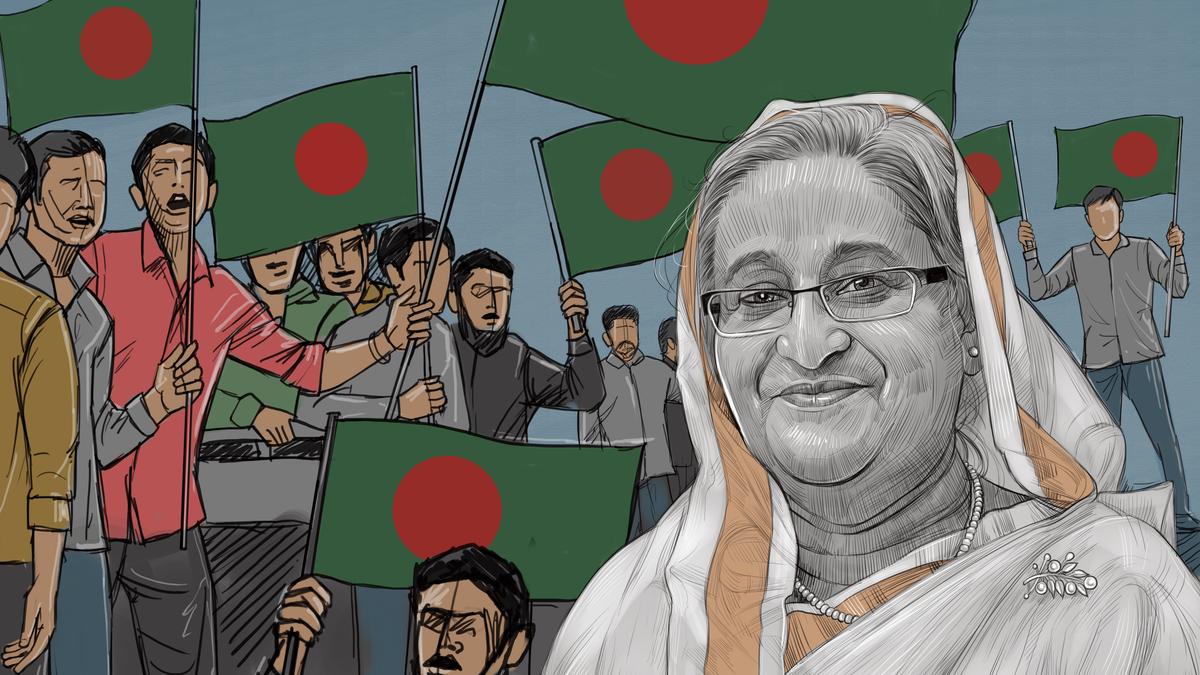
When the deposed Bangladesh PM arrived at the Hindon air base on 5 August, 10 miles outside New Delhi, Ajit Doval was waiting to greet her in these hours of tumult. Presence of India’s National Security Advisor, one of PM Modi’s most trusted aide’s at this critical juncture signifies the importance Modi government attaches to the political capital of Awami League.
Irrespective if the former Bangladesh PM seek asylum in UAE or Finland, as spelled out by her son Sajeeb and despite the fact that India knows it cannot refuge former BD PM for long, New Delhi appears willing to risk relations with post-AL Dhaka.
Sheikh Hasina has always enjoyed lifelong deep trust with India. It was in 1975 when she took refuge in India, following assassination of her father Sheikh Mujibur Rahman and family members. While recent past suggest remarkably cozier ties between the AL-ruled BD and BJP led Modi government, one must not forget Hasina had even closer relations with the Gandhi family.
Since May 2014, when Nareendra Modi was elected as prime minister, the two countries have seen close economic and defence ties, so much that the bilateral trade between the two countries exceeded $ 15 billion last year. While economies of India and Bangladesh grew faster in region in the last ten years, illiberal tendencies by both Modi and Hasina Sheikh too gave way to democratic values much to the discontent of masses in general.
Growing anti India sentiments can be attributed to India’s tacit approval of rights violations by Sheikh Hasina. Not only did India lost sway over Dhaka, at least in the near future, recent months have also seen anti-India sentiments in Bangladesh over repressive policies of Sheikh Hasina. Crackdown on radical Islamist groups including Jamaat e Islami also contributed to anti-India feelings. Having lost a trusted ‘friend’ India has already beefed up security along the border with Bangladesh.
More worrying for India would be any tilt in China’s favour by the future Bangladesh government. With Sheikh Hasina at the helms, Bangladesh had maintained balance in relations with China without irking their western friendly neighbour. That leverage India had so far enjoyed in the region, is no more. The incumbent military chief, might be keen to acquire military hardware from China, as the reports suggest.
Instability in Myanmar is one of the Indian vulnerabilities when it comes to eastern neighbourhood. Now the recent political unrest in Bangladesh has simply added challenges to India’s key strategic projects aimed at regional connectivity. India’s concerns are growing with possibilities of interim government working alongside political forces closer toy Pakistan and China.
As anxiety grows in Nepal and Maldives over Hindu nationalist Modi policies, ouster of Sheikh Hasina is seen as waning influence of India in the region. Growing military ties between Bangladesh and China may well become a major setback for India. If that happens, India’s increasing regional woes may result in backlash on domestic front.
At the time when PM Modi is seeking a greater role in international politics by attempting peace initiatives between Russia and Ukraine, its antagonistic approach towards next-door neighbours may spell foreign policy disaster for India.
Emerging political picture in Bangladesh offer great advantages to Pakistan and China, given the fact that Bangladesh’s interim setup will be more than willing to realign foreign policy and renew bilateral ties with Pakistan.
Its time now for Pakistan to come out of security oriented approach and work for long term strategic gains in the region. Inability on our part to reset ties according to the current political weather may allow other regional actors take advantage of scenario. A rethink on Pakistan’s part is vital for safeguarding geopolitical interests.
While it will be too early to underwrite political capital of Awami League, India’s National Security Advisor may still have to make sense of an uncertain political future of Bangladesh, increased role of military, possibility of BNP returning to power and, maybe, roller-coaster return of Islamic political forces giving Pakistan’s sinking regional role a new lease of life.
On a sultry Delhi afternoon, as Ajit Doval steers Sheikh Hasina to a safe house, sleepless nights await Modi’s national security advisor who failed to calculate virulent oppositions that have deprived India of a trusted partner in regional settings.